Back in 2006, Flickr user André Rabelo submitted the above photograph to the group pool of DeleteMe!, a group whose members vote on photos to weed out any photos that aren’t “incredible pictures, amazing, astonishing, perfect”. Sadly, the photograph was very quickly removed by popular vote. I was stunned to read about this a few days ago. Goes to show that appealing to the lowest common denominator is not the way to stand out in photography or any art form. Trust your vision. If popularity was the barometer of quality then McDonald's would be a five star restaurant and romantic comedies would win all the Oscars. True art stands the tests of time my friends.
Here are some of the moronic critiques of the above photograph.
"When everything is blurred you cannot convey the motion of the bicyclist. On the other hand, if the bicyclist is not the subject-- what was?
"This looks contrived, which is not a bad thing. If this is a planned shot, it just didn't come out right. If you can round up Mario, I would do it again. This time put the camera on a tripod and use the smallest aperture possible to get the best DoF [depth of field]. What I would hope for is that the railings are sharp and that Mario on the bike shows a blur. Must have the foreground sharp, though. Without that, the image will never fly."
"It's just very awful"
"so blurry.... to better show a sense of movement SOMETHING has to be in sharp focus!"
Yup, Man Ray said it best "All critics should be assassinated." This is precisely why I stay off forums and sites like Flickr (although I have an account). Too many morons acting like experts when they have no clue at all what they are talking about.
The above image “Hyeres, France, 1932″ was sold at auction in 2008 for a staggering $265,000. So suck it Flickr Philistines!
Arnold Newman is one of the most renowned portrait photographers of the 20th century. His photos of artists and musicians, presidents and prime ministers, are instantly recognizable as his work.
Newman was born in New York City in 1918 and studied painting and drawing. With a strong interest in the arts, he accepted a scholarship to study at the University of Miami. His teacher at the university, a conservative artist, pointed him in the direction of modernism, and encouraged him to visit the Museum of Modern Art in New York. When he switched from painting to photography in 1938, it was first for financial reasons during the Depression, but then he came to love the field
Arnold Newman is often credited with being the first photographer to use so-called 'environmental portraiture', in which the photographer places the subject in a carefully controlled setting to capture the essence of the individual's life and work. Newman normally captured his subjects in their most familiar surroundings with representative visual elements showing their professions and personalities. A musician for instance might be photographed in their recording studio or on stage, a Senator or other politician in their office or a representative building. Using a large-format camera and tripod, he worked to record every detail of a scene.
"I didn't just want to make a photograph with some things in the background," Newman told American Photo magazine in an interview. "The surroundings had to add to the composition and the understanding of the person. No matter who the subject was, it had to be an interesting photograph. Just to simply do a portrait of a famous person doesn't mean a thing."
Newman's best-known images were in black and white, although he often photographed in color. His black and white portrait of Igor Stravinsky seated at a grand piano became his signature image, even though it was rejected by the magazine that gave the assignment to Newman. He was one of the few photographers allowed to make a portrait of the famously camera-shy Henri Cartier-Bresson.
Among Newman's best-known color images is an eerie portrait that shows convicted former Nazi slave labor boss Alfried Krupp in one of Krupp's factories.
Arnold Newman, Self Portrait, 1939
Dali
Newman at work
Picasso
Original 4x5 Image for above Portrait of Picasso
Igor Stravinsky, Russian Composer, Pianist and Conductor, 1946
Woody Allen
Portrait of German industrialist Alfried Krupp July 6, 1963 in Essen, Germany
JFK
Helen Hayes
VIOLINS, PHILADELPHIA, PA, 1941
Marcel Duchamp
Artist Joan Miró
"Visual ideas combined with technology combined with personal interpretation equals photography. Each must hold it's own; if it doesn't, the thing collapses." ~Arnold Newman
Marilyn Monroe
Man Ray
Jackson Pollock
Photographer Alfred Stieglitz and artist wife Georgia O'keeffe
Frank Lloyd Wright, Architect, 1947
Isamu Noguchi, Japanese American artist and Furniture designer
Henri Cartier-Bresson
Ansel Adams, American Photographer, 1975
Jean Dubuffet, French Painter and Sculptor, 1956
“There are no rules and regulations for perfect composition. If there were we would be able to put all the information into a computer and would come out with a masterpiece. We know that's impossible. You have to compose by the seat of your pants"
~ Arnold Newman
1970 | Arnold Newman, Ritratto di Barnett Newman
Frank Stella, American Painter, 1967
Marc Chagall, Russian/French Painter, 1942
Marc Chagall, 1956
Roy Lichtenstein, American Pop Artist, 1976
Pablo Picasso, Cannes, 1956
Piet Mondrian, New York' 1942
Artist Francis Bancon, NYC,
Andy Warhol, The Factory, 1973
Max Ernst, New York, NY, 1942
George-Grosz-1942
Alexander Calder, Connecticut, 1957
JFK before he became president.
Watch this video. Great insight into the work and mind Newman
Many photographers are gear heads; myself included... to an extent. Unfortunately many photographers are overly concerned about equipment. Insistent on getting the sharpest, fastest lenses available, or the latest camera with highest mega-pixel count. Some shooters have every lens imaginable. Henri Cartier-Bresson is arguably one of the best photographers in history and he used cameras equipped with just a 50mm lens or occasionally a wide-angle for landscapes.
And of course we have the endless Nikon vs Canon debate. Or some Leica users wearing the camera as a status symbol and would lose their minds if their Leica were to ever get a scratch on it. Have they seenJim Marshall's camera?
The camera is a just a tool. Sure good tools are important but the image is everything. Stop pixel peeping, reading reviews on lenses and cameras and go out and shoot!
Here are some great quotes that may illuminate more on this topic:
"We don't take pictures with our cameras. We take them with our hearts and we take them with our minds, and the camera is nothing more than a tool." ~ Arnold Newman
"I always kept my equipment down to a minimum two cameras, each with three lenses, a flash that would clip onto the camera body, and one assistant. I did not want to spend time thinking about hardware; I wanted that time to concentrate on the girl and the world around her." ~ Helmut Newton
"There is nothing worse than a sharp image of a fuzzy concept" - Ansel Adams
"The single most important component of a camera is the twelve inches behind it." ~ Ansel Adams
Jay Meisel shakes his head when the first question out of his students mouths after seeing one of his images is "What kind of camera do you use"
"Most of the questions I am asked about my pictures is what camera I used to take that picture. It seems that we have become worshippers of the tools rather than the images, or perhaps subconsciously believe the most advanced camera will narrow the competition. It is my belief that as a photographer, one is only in competition with one's self " ~ Melvin Sokolsky
"I recently went to an opening at the Fahey/Klein Gallery in Los Angeles showing Nick Brandt’s beautiful animal pictures of the endangered species in Africa called, “A Shadow Falls.” I was amused by the question that everyone asked after greeting Nick. 'What camera do you use?' " ~ Melvin Sokolsky
Walker Evans once said "People always ask me what camera I use. It's not the camera, it's - - - " and he tapped his temple with his index finger.
"Leica, schmeica. The camera doesn't make a bit of difference. All of them can record what you are seeing. But, you have to SEE." ~ Ernst Haas
"Best wide-angle lens? 'Two steps backward' and 'look for the ah-ha'." ~ Ernst Haas
"Photographers — idiots, of which there are so many — say, “Oh, if only I had a Nikon or a Leica, I could make great photographs.” That’s the dumbest thing I ever heard in my life. It’s nothing but a matter of seeing, thinking, and interest. That’s what makes a good photograph. And then rejecting anything that would be bad for the picture. The wrong light, the wrong background, time and so on. Just don’t do it, not matter how beautiful the subject is." ~Andreas Feininger
Having the same paints and brushes as Piccaso doesn't make you a Picasso and driving a Ferrari doesn't make you Michael Schumacher It all comes down to you not the camera
"Most people stiffen with self-consciousness when they pose for a photograph. Lighting and fine camera equipment are useless if the photographer cannot make them drop the mask, at least for a moment, so he can capture on his film their real, undistorted personality and character. " ~ Halsman
So what are you waiting for?...Go out and shoot and have fun!
Henri Cartier-Bresson (1908–2004) is one of the most original, accomplished, influential, and beloved figures in the history of photography. His inventive work of the early 1930s helped define the creative potential of modern photography, and his uncanny ability to capture life on the run made his work synonymous with “the decisive moment”—the title of his first major book.
After World War II (most of which he spent as a prisoner of war) and his first museum show (at MoMA in 1947), he joined Robert Capa and others in founding the Magnum photo agency, which enabled photojournalists to reach a broad audience through magazines such as Life while retaining control over their work.
In the decade following the war, Cartier-Bresson produced major bodies of photographic reportage on India and Indonesia at the time of independence, China during the revolution, the Soviet Union after Stalin’s death, the United States during the postwar boom, and Europe as its old cultures confronted modern realities. For more than twenty-five years, he was the keenest observer of the global theater of human affairs—and one of the great portraitists of the twentieth century. ~ viaMoMA
"To photograph is to hold one's breath, when all faculties converge to capture fleeting reality. It's at that precise moment that mastering an image becomes a great physical and intellectual joy."
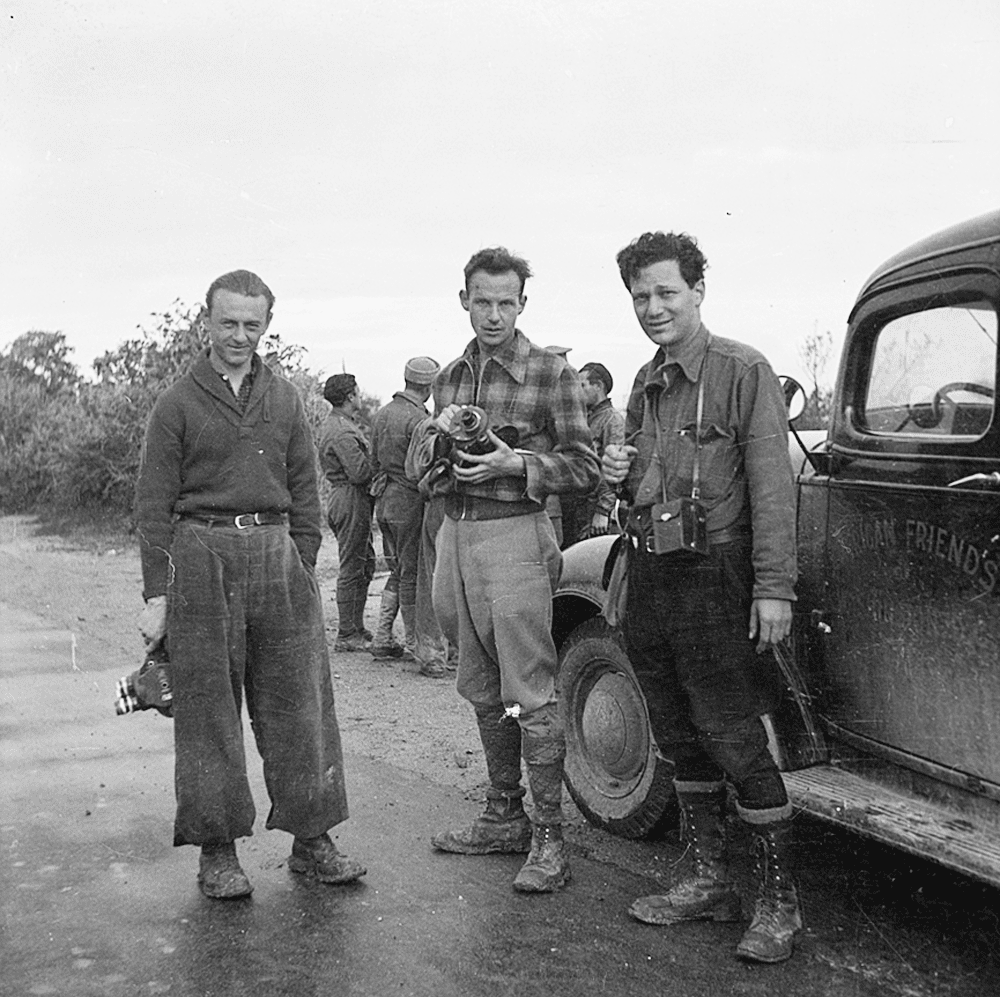
Henri Cartier-Bresson is in the middle
Cartier-Bresson's First Leica
Alberto GIACOMETTI, at his home. 1961
Matisse
Prostitute, Calle Cuauhtemoctzin
Mexico City, 1934
Sculpter Alberto Giacometti by Cartier-Bresson Photo.